Auxiliary Verb (Irregular) (Basic ㊦ 221)
An auxiliary verb which indicates the beginning of some process or continuation of some action up to a current point of time.
Equivalent: Come about; grow; come to; begin to
| (i) Vて | 来る | |
| 膨らんで来る | Something begins/has begun to swell | |
| 大きくなって来る | Something begins/has begun to grow big |
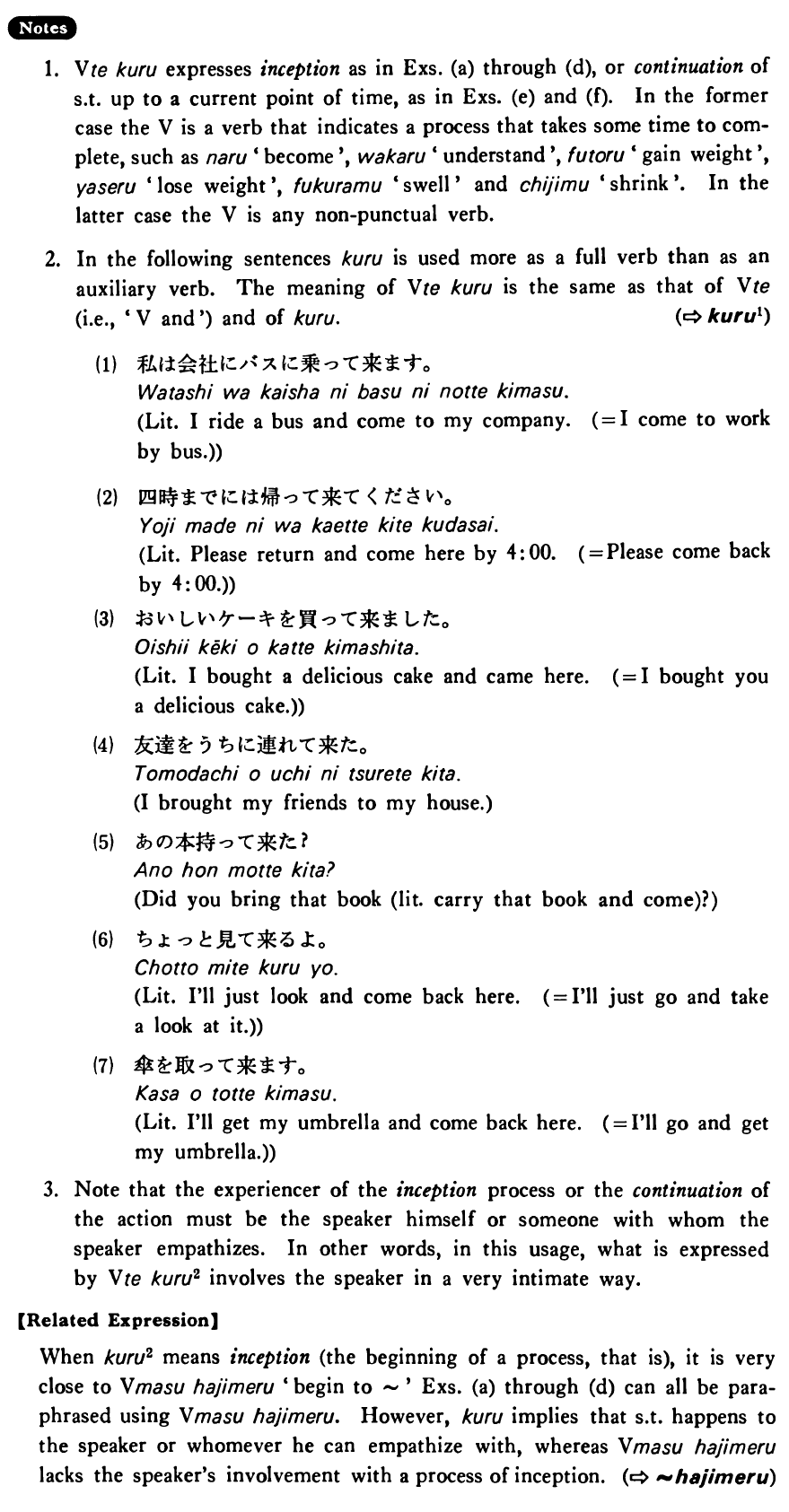
1. Verbて来る expresses inception as in Examples (a) through (d), or continuation of something up to a current point of time, as in Examples (e) and (f). In the former case the Verb is a verb that indicates a process that takes some time to complete, such as なる 'become', 分かる 'understand', 太る 'gain weight', 痩せる 'lose weight', 膨らむ 'swell' and 縮む 'shrink'. In the latter case the Verb is any non-punctual verb.
2. In the following sentences 来る is used more as a full verb than as an auxiliary verb. The meaning of Verbて来る is the same as that of Verbて (i.e., 'Verb and') and of 来る.
(⇨ 来る1)
3. Note that the experiencer of the inception process or the continuation of the action must be the speaker himself or someone with whom the speaker empathizes. In other words, in this usage, what is expressed by Verbて来る involves the speaker in a very intimate way.
【Related Expression】
When 来る2 means inception (the beginning of a process, that is), it is very close to Verbます始める 'begin to ~' Examples (a) through (d) can all be paraphrased using Verbます始める. However, 来る implies that something happens to the speaker or whomever he can empathize with, whereas Verbます始める lacks the speakers involvement with a process of inception.
(⇨ 始める)